
The Data Every Worker Over 45 Needs to See — And Act On
Retirement & Financial Planning
The question is not whether AI will change your workplace. It already has. The real question — the one that matters for your financial future — is whether you will be ready if it changes yours sooner than you planned.
Let the numbers speak first.
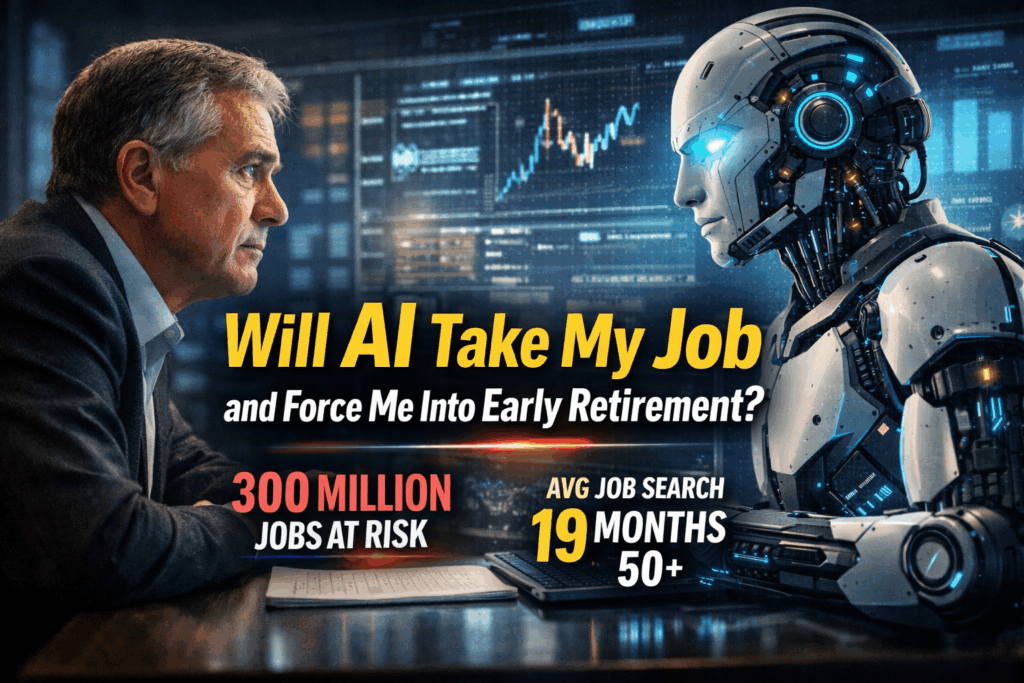
| 300M Jobs globally affected by AI automation (Goldman Sachs, 2023) | 62% of workers aged 50+ worry AI will make their skills obsolete (AARP, 2024) | 19 mo. Average job search duration for displaced workers over 50 (Urban Institute) |
If you are between 45 and 65, those numbers land differently than they do for a 30-year-old. A 30-year-old has time to pivot, retrain, and recover. You may have a shorter runway — which means the margin for error in your financial plan just got smaller.
What the Research Actually Shows About AI and Job Displacement
The most comprehensive studies on AI and employment share a consistent finding: it is not entire jobs that disappear first — it is tasks within jobs. When enough tasks are automated, headcount follows.
A 2023 report from McKinsey Global Institute projects that by 2030, up to 30% of hours currently worked in the U.S. economy could be automated by AI — with the steepest impact falling on office and administrative roles, financial operations, and customer-facing service jobs.
These are not hypothetical projections anymore. They are already happening in boardrooms:
- IBM paused hiring for ~7,800 roles it expects AI to replace within five years
- BT Group (a major UK telecom) announced plans to cut 55,000 jobs, with AI cited as a key driver
- Law firms are using AI to complete document review that previously required dozens of paralegals and junior associates
- Major banks are deploying AI for credit analysis, fraud detection, and client onboarding — tasks that once required entire departments
The pattern: mid-level, cognitive, routine knowledge work is at highest risk — and that describes a large portion of the workforce between ages 45 and 65.
Industry-by-Industry Risk Snapshot
No industry is fully insulated, but risk levels vary significantly. Here is what the data shows across key sectors:
Healthcare Administration — HIGH RISK
Clinical roles remain protected — nurses, physicians, and therapists are hard to automate. But the administrative layer of healthcare (billing, coding, scheduling, prior authorizations) is being rapidly automated. These roles employ millions of workers over 45.
Legal & Compliance — MODERATE-HIGH RISK
AI tools are performing contract review, legal research, and regulatory analysis at a fraction of the cost of human paralegals and junior attorneys. Senior partners and trial lawyers are safer; support staff are highly exposed.
Manufacturing & Logistics — MODERATE RISK (Ongoing)
Automation in manufacturing is not new, but AI is accelerating quality control, supply chain management, and predictive maintenance — eliminating supervisory and mid-management roles that have traditionally been held by experienced workers.
Education & Government — LOWER RISK
These sectors move more slowly and involve significant regulatory and human-interaction components. However, administrative and analytical roles within these sectors are not immune.
Skilled Trades — LOWEST RISK
Plumbers, electricians, HVAC technicians, and contractors require physical presence and real-time problem solving that AI cannot replicate. Ironically, workers in these fields may have more job security than many white-collar professionals.
The Retirement Math Nobody Is Talking About
Here is where the data becomes deeply personal. If you lose your job at 55 and cannot find comparable re-employment — which the data suggests is a real possibility — you face a compounding financial problem:
- Lost peak earning years: Your highest-earning years are typically your 50s and 60s. Losing them early cuts off your most powerful savings window.
- Reduced Social Security benefits: Claiming Social Security at 62 instead of 67 permanently reduces your benefit by approximately 30%.
- Longer retirement to fund: Retiring at 58 instead of 65 means funding 7 additional years of expenses — potentially adding $300,000 to $500,000+ to your retirement need.
- Healthcare cost gap: Medicare eligibility begins at 65. An early retirement can leave you with years of unsubsidized private insurance costs averaging $800 to $1,200+ per month.
- Sequence-of-returns risk: Withdrawing from retirement accounts during a down market in your early retirement years can permanently impair your portfolio’s longevity.
| $500,000+ Estimated additional retirement funding needed if you retire at 58 instead of 65 — factoring in lost savings, reduced Social Security, and healthcare costs. |
The math is unforgiving. But it is also manageable — if you start planning before the disruption reaches you.
Five Data-Backed Steps to Protect Your Financial Future Now
1. Develop a Bridge Income Strategy
If your primary career is disrupted, what can generate income? Part-time consulting in your field, monetizing a skill or expertise, rental income, or a phased retirement arrangement with your current employer are all worth modeling now — before you need them. Having a bridge income plan is the foundation everything else is built on.
2. Model an Early-Retirement Scenario Today
Run your retirement projections assuming you stop working 3 to 7 years earlier than planned. This is not pessimism — it is financial risk management. Knowing your numbers gives you options; not knowing them leaves you exposed.
3. Build a 12-Month Liquid Reserve
The standard 3-to-6-month emergency fund was designed for short job searches. Research shows workers over 50 take an average of 19 months to find re-employment after displacement. Extend your cash runway to at least 12 months so you are not forced to liquidate retirement assets at the worst time.
4. Maximize Catch-Up Contributions Aggressively
If you are 50 or older, the IRS allows annual catch-up contributions of $7,500 to a 401(k) and $1,000 to an IRA (2024 figures). Workers who max these out consistently in their 50s can add $150,000 to $200,000+ to their retirement balance over a decade. Every year you delay is compounding you are giving up.
5. Stress-Test Your Portfolio Against Sequence Risk
An early retirement means your portfolio is more vulnerable to a market downturn in the first few years of withdrawal. Work with a financial advisor to evaluate whether your current asset allocation is appropriate for a potentially longer — and earlier — retirement horizon.
The Bottom Line: Your Retirement Timeline May Be Shorter Than Your Plan Assumes
The data is consistent across every major research institution that has studied this: AI will displace a meaningful share of knowledge workers over the next decade, older workers face steeper re-employment challenges than younger ones, and the financial consequences of an unplanned early retirement are significant.
The workers who will weather this best are not necessarily those with the most AI-proof careers. They are the ones with the most financially resilient plans — built before the disruption arrives.
The best time to stress-test your retirement plan was five years ago. The second-best time is right now.
At Strategies For Wealth Management, we specialize in helping people build a ROCK SOLID Retirement Plan. These plans are built for uncertainty — not optimistic assumptions.
Contact us today:
📞 866-701-ROCK (7625)
✉️ info@strategies4wm.com
🌐 www.strategies4wm.com
Frequently Asked Questions
How many jobs will AI actually eliminate?
Goldman Sachs estimates 300 million jobs globally could be affected. McKinsey projects up to 30% of U.S. work hours could be automated by 2030. Most researchers agree full job elimination is less common than task automation — but task automation still drives headcount reduction.
Am I too old to adapt my skills for an AI-driven workplace?
No. Studies show that workers who learn to use AI tools effectively — rather than compete against them — maintain strong employability. Platforms like LinkedIn Learning, Coursera, and Google Career Certificates offer targeted, affordable upskilling that does not require going back to school full-time.
What is the biggest financial mistake people over 50 make when facing job displacement?
Raiding retirement accounts early. Early withdrawals trigger income taxes plus a 10% penalty, and permanently reduce the compounding growth your future self was counting on. A proper emergency fund is the defense against this mistake.
When should I start planning for the possibility of early retirement?
Now — regardless of how secure your job feels today. Building financial resilience takes years, not weeks. The time to plan for a storm is before it arrives.